Written by Jean F. Andrews
Signed by Beverly Buchanan
Hi, I’m Beverly Buchanan, a professor at the University of North Florida, where I prepare
interpreters and conduct linguistic research.
Many Deaf children, tragically, become involved in the juvenile justice system without basic literacy skills to understand their crimes or the consequences. Often, Deaf kids don’t develop early language skills because they lack access. But what if pediatricians, ENTs, and pediatric audiologists intervene by showing caregivers how to read and fingerspell with their child? These medical professionals often serve as gatekeepers while providing hearing health care. They could provide this service during well-child visits.
A program like this could jump-start literacy and help limit early language deprivation and the many social, cognitive, and mental health risks that a large number of Deaf children face. The Reach Out and Read program is a nonprofit supported by multiple funding agencies and recommended by the American Academy of Pediatrics. It serves 4.8 million children nationwide. During the well-child developmental assessment, pediatricians and nurse practitioners provide each child with free, age-appropriate storybooks. The pediatrician spends a few minutes demonstrating caregiver-child interactive reading, observes how the child responds, and then records these interactions as part of the child’s well-visit assessment. The doctor coaches the caregiver on the process and encourages them to continue regularly at home, making book sharing part of their everyday routine. Coaching includes pointing to and naming pictures and objects and asking simple questions.
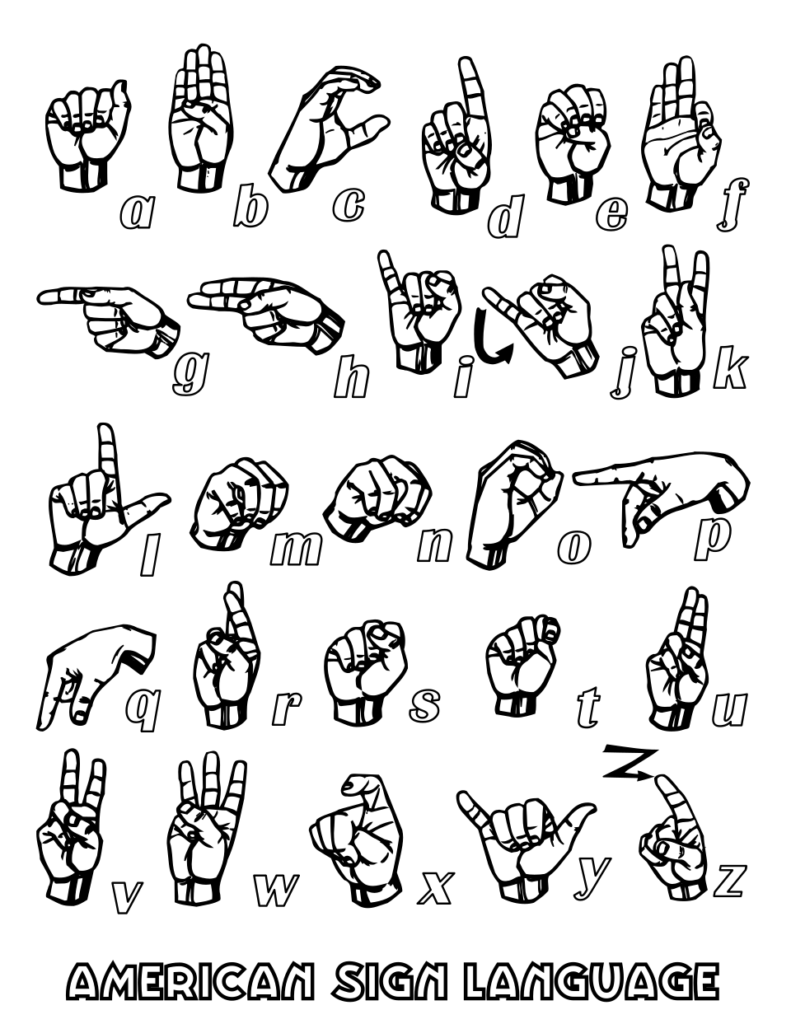
ASL Fingerspelling alphabet courtesy: Wikipedia
Who would have thought a doctor’s visit could be more than a stinging shot or bitter medicine and include fun storybook interactions? What if the Reach Out and Read Program expanded to include healthcare professionals interacting with Deaf children and added Fingerspelling into the training? Fingerspelling is relatively easy to learn initially and, with practice, can become physical memory fairly quickly. Doctors and nurses can fit it into their busy workload with little difficulty.
Professor Sharon Baker and her colleagues found that Deaf mothers introduced fingerspelling to their babies soon after birth. One mother leaned over the crib and fingerspelled 26 letters of the alphabet every evening as a good night lullaby. Deaf mothers, wise in their child-rearing ways, stimulate their babies’ brains by fingerspelling handshapes to help them with visual attention, motor development, speech, and even spelling short words as they get older.
If pediatricians, ENTs, and pediatric audiologists combine their well-child developmental visits with shared reading and Fingerspelling, they can help build healthy, nurturing relationships, lay the foundation for early literacy to benefit all Deaf children, and provide a protective layer for future vulnerable Deaf youths who need literacy skills to navigate the legal system. This could start right in the pediatrician’s office.

Can you read this?
See resource links below:
The Language Arts Handbook: A Total Communication Approach by Joanne C. Greenberg, McCay Vernon, Jan Hafer DuBois, and Jan C. McKnight (1982). University Park Press.
Editor’s note: Although I’m sure this is an excellent resource, I couldn’t find any current links. I do know that the Joanne Greenberg mentioned here, is not our founding contributor and author of “In This Sign.” If you know of a way to access this resource, please leave a link in the comments.
School-to-Prison Nexus: Deaf Youth and the Juvenile Justice System. By Gabriel I. Lomas. In Deaf People in the Criminal Justice System: Selected Topics on Advocacy, Incarceration, and Social Justice. (pp. 63-81). Gallaudet University Press.
Comments are closed